Is all WEL? What do the Proposed Exposure Limits Mean for Mining?
At the recent Australian Institute of Occupational Hygienists (AIOH) Conference, GCG occupational hygienists Paul Richardson and Peter Franchina prepared a poster examining the potential impact of proposed changes to Australia’s workplace exposure limits.
Their work examined a question that may not yet be widely appreciated across the mining sector: what might some proposed Workplace Exposure Limits (WELs) mean in practice for underground mining operations?
The analysis focused on nitrogen dioxide (NO₂) and explored how historic exposure data from Western Australian mines would compare against the limit currently under consultation.
The results suggest the implications could be significant.
A Proposed Reduction in the Nitrogen Dioxide Limit
Australia is currently moving toward replacing the long-standing Workplace Exposure Standards (WES) framework with a new set of Workplace Exposure Limits (WEL).
While the change may sound administrative, some of the proposed limits represent substantial tightening of allowable exposures.
For nitrogen dioxide, the current time-weighted average (TWA) WES is 3 ppm. One of the policy options currently under consultation as part of the WEL framework, proposes reducing that limit to 0.2 ppm – a 93% reduction.
In underground mining environments, where NO₂ is typically generated by diesel equipment and blasting activities, exposure is largely managed through ventilation systems, equipment maintenance and operational controls.
A change of this scale, therefore, raises an obvious question: how would current exposure profiles compare against the proposed limit?
What the Historic Data Suggests
To explore that question, Paul and Pete reviewed a large dataset of historic monitoring results from underground mining operations in Western Australia.
The dataset included 2,711 personal NO₂ monitoring results collected across a range of sites and operating conditions. These results were then considered against both the current WES and the proposed WEL.
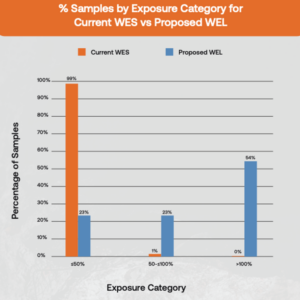
Figure 1. Historic underground mining NO₂ monitoring results compared against the current WES (3 ppm) and a proposed WEL (0.2 ppm).
What the comparison shows is quite striking.
Under the current standard, very few samples exceed the existing exposure limit. However, when the same dataset is assessed against the proposed WEL of 0.2 ppm, the picture changes dramatically, with more than half of all samples exceeding the proposed limit.
In other words, exposures that are currently considered compliant across many operations would become non-compliant in a large proportion of cases if the proposed limit were introduced.
Why This Matters for Mining Operations
If limits are tightened to this degree, the response required is unlikely to be limited to small procedural adjustments.
For many underground operations, achieving compliance could require changes to ventilation performance, diesel equipment emissions, fleet replacement, maintenance programs or operational practices. Monitoring programs may also need to evolve to provide a clearer picture of exposure conditions and control effectiveness.
These types of changes typically require engineering assessment, operational planning, and often capital investment. They are not adjustments that can be implemented overnight.
A Shift Toward Tighter Exposure Expectations
The move from WES to WEL reflects a broader shift toward more health-based exposure limits and stronger expectations around exposure control.
For industries such as underground mining, where airborne contaminants are an inherent part of the operating environment, the implications may not be immediately obvious until proposed limits are compared with actual monitoring data.
That was the intention behind the analysis presented by Paul Richardson and Peter Franchina through the AIOH poster competition. Not to draw conclusions about any particular operation, but to illustrate how seemingly small regulatory changes can have very real operational implications when viewed against historic exposure profiles.
As consultation on the proposed limits continues, organisations may find value in reviewing their own monitoring data and considering what the proposed WEL values could mean in practice.
Early awareness provides time to plan. And in environments where significant time and capital investment can be required to implement controls, that lead time can make all the difference.
There’s been a lot of focus in recent years on respirable crystalline silica – and for good reason. Across Australia and globally, dust exposure is coming under heavier scrutiny, and the need for more responsive, data-driven approaches to managing dust…
Substitution gone wrong – a case study of hexavalent chromium occurrence in exhaust systems
Calcium chromate is a toxic, yellow coloured powdery compound. It is a strong oxidising agent and can be used as a corrosion inhibitor and to depolarise batteries. It is also produced when chromium is present with an oxidant, such as…
Real-time dust monitoring has really come into its own in the last few years. The ubiquity of real-time monitoring devices and the recent emergence of intelligent dust exposure control applications and platforms like GCG’s ‘Exposi’ system have taken monitoring and…
Increased awareness of silicosis and other occupational lung diseases caused by exposure to hazardous levels of respirable crystalline silica has prompted employers and workers to seek ways to reduce the potential for worker exposure to hazardous dust. This has driven…
How can a work health and safety management system help my business?
A work health safety management system (WHSMS) A WHSMS is a systems-based approach to help companies manage their work health and safety risks and maintain compliance with current legislative requirements. What is a work health and safety management…